
Sports Photography Tips - Seeing a Photograph.
 In this article I want to make some very ‘woolly’ non-technical suggestions for ways to improve your photographic skills.
If that last sentence makes no sense I am not surprised. Hopefully as you read on though, my thoughts here will become clearer.
Whilst this article is not neccessarily sports related, it certainly helps me in my approach to what I hope is a creative photographic process no matter what the genre.
In this article I want to make some very ‘woolly’ non-technical suggestions for ways to improve your photographic skills.
If that last sentence makes no sense I am not surprised. Hopefully as you read on though, my thoughts here will become clearer.
Whilst this article is not neccessarily sports related, it certainly helps me in my approach to what I hope is a creative photographic process no matter what the genre.
Photography is about what you see, what you want to see and what you want to create as a visual two-dimensional vision.
There are some fairly simple technical concepts to learn and once they are mastered, your photographic output will be limited only by your ability
to see a photograph in your mind and your imagination to create a photograph.
When you are competent with your camera and itching to create stunning imagery, you will have to learn to ‘see’ photographs. Personally,
I am obsessed with photographs and my eye is constantly seeing potential photographs. These are the visions of the scenes my photographic eye sees as
I go about my daily life and when I see something that I think I should capture and photograph, I make a mental note or I write down what I have seen
for future reference.
The ‘seeing’ part is what starts the creation of any of my photographs and it is this ‘seeing’ that you have to develop. This is not something you can
rush and it comes only with time as you develop your own style of photography and as you decide what you like and what you don’t like to photograph.
This probably sounds a little woolly even now and I am struggling to really nail down the concept of ‘seeing’.
Perhaps an example will make things clearer. You are out on a walk in the countryside and you come over the brow of a hill and facing you is a beautiful vista.
If you notice that is has photographic potential then you are already ‘seeing’ but there is more to this than just identifying a scene. Once you have found a
potential photograph, the key to really ‘seeing’ is to imagine the scene as a 2-dimensional photograph in your minds eye. Now you can decide if the scene will
look that great and if there are other vantage points that will give you a better angle to create a more dramatic photograph. Understanding how you see and
how that transfers to a photograph will help you decide what will work as an image and what won’t work.
 Eventually you will have a hard time switching this ‘seeing’ off. You will find yourself looking at everything on two levels, one as part of your everyday
activity and then what will become a sub-conscious action you will see if what you see before you has the potential for an image.
Eventually you will have a hard time switching this ‘seeing’ off. You will find yourself looking at everything on two levels, one as part of your everyday
activity and then what will become a sub-conscious action you will see if what you see before you has the potential for an image.
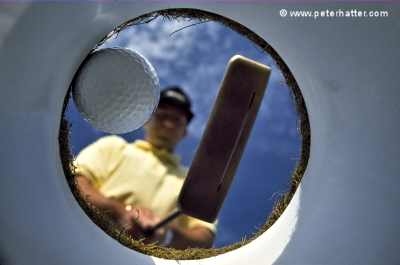
The golf image I have included at the top of this article is one I created after having an idea. This image was created in my head long before I pressed the shutter.
I had to 'see' it first.
Perhaps this makes no sense at all to you and if not I completely understand. This ‘seeing’ business is how I create my photographs and this might not be the
process that you choose to use but it does work for me and perhaps you can make some use of this very woolly concept I have described above.
To me this is the most important one of all as it is the core of how I have developed a style as a photographer. What you see will decide what you commit to a
photograph and you never stop developing your ‘eye’ for a photograph. Your images will change over time as what you see changes.
If you enjoyed this article why not take a look at our next article, Be More Than Just a Button Pusher - Click Here.
Remember to always think safety first when you're out shooting sports. Never put yourself or others in danger and always observe all safety notices and instructions.
