
Sports Photography Tips - Canoe Slalom.
 As a sports photographer one of the things I look for is action and drama and over the years I have found that white water canoeing offers fantastic
opportunities for both.
The canoe slalom and freestyle disciplines see paddlers competing on a white water course where they demonstrate their skill in different styles of boat and it is
these events that I have found to produce great action opportunities. Slalom canoeists have to negotiate a series of gates through which they have to pass on their
way down a set course doing so in the fastest time possible. Freestyle canoeists perform tricks and manoeuvres on the water, being scored on the skill and complexity
of their moves. Both sports involve lots of fast moving white water with highly skilled competitors in the middle of it.
As a sports photographer one of the things I look for is action and drama and over the years I have found that white water canoeing offers fantastic
opportunities for both.
The canoe slalom and freestyle disciplines see paddlers competing on a white water course where they demonstrate their skill in different styles of boat and it is
these events that I have found to produce great action opportunities. Slalom canoeists have to negotiate a series of gates through which they have to pass on their
way down a set course doing so in the fastest time possible. Freestyle canoeists perform tricks and manoeuvres on the water, being scored on the skill and complexity
of their moves. Both sports involve lots of fast moving white water with highly skilled competitors in the middle of it.
So how do you go about photographing these sports? The first thing you have to do is find the points on the course where the action is likely to be. There will be
spots where the canoeists are just paddling across flat water and these are not really of interest. What you are looking for are the places where the water
is being churned by obstacles under the surface producing the fast moving white water. Here is where you find the essence of these canoe sports. The competitors
have to use their skill and experience to negotiate the hazards and it is these locations on the course that provide the high-action photo opportunity.
Most courses will have points where you can be close to the competitors and take action images that don't require you to have a huge lens to create nicely composed
tight photographs. A 70-200mm lens will be capable of getting close enough to many points on the course and is a lens which most photographers have access to.
I like to arrive early at an event, before things get started, so I can walk the course and find the places that will produce the best photographs.
If I am photographing a slalom event I check out the gates and find those that look to be the most difficult to negotiate. Knowing the canoeist passes
through this point means you can predict where the action will be and offers the greatest chance of capturing the action.
However there is more to choosing a location than just the action. Many people make the mistake of ignoring what is in the background of the shot.
This can ruin a great image. So ensure the background is as neutral as possible and does not distract you from the canoe action.
A tool for reducing background distraction is a wide aperture, this reduces depth of field and so unwanted elements of your image will be out of focus.
A wide aperture of f4.0 is ideal for blurring the background. Watch out for brightly coloured objects as even when blurred they will become obtrusive patches
that take your eye away from the canoeist in your final photograph.
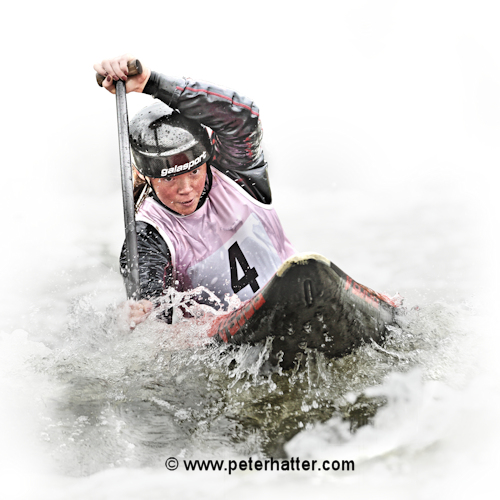 When you have found your ideal spot and are ready for the action to start we turn our attention to capturing the canoeist on the course. One of the key elements
of these sports is the white water. To freeze the action and the water you will need to use a fast shutter speed. If you are using a wide aperture like f4.0, or
f2.8 if your gear offers it, with an aperture priority mode set on your camera you are automatically likely to use the fastest shutter speeds available in the
lighting conditions that prevail at the time. I have found that 1/300th of a second is the minimum shutter speed and if possible I like to use an even faster
speed such as 1/500th as this is great for freezing the paddler and the water droplets around them.
If you are using an automatic mode exposure such as shutter or aperture priority the bright white water may fool your camera in to under-exposing the photograph.
If your camera has an exposure compensation feature use this to increase the exposure time. Then check the image review and histogram to ensure the exposure is accurate.
Always take test shots before you take your actual images to ensure exposure is correct.
When you have found your ideal spot and are ready for the action to start we turn our attention to capturing the canoeist on the course. One of the key elements
of these sports is the white water. To freeze the action and the water you will need to use a fast shutter speed. If you are using a wide aperture like f4.0, or
f2.8 if your gear offers it, with an aperture priority mode set on your camera you are automatically likely to use the fastest shutter speeds available in the
lighting conditions that prevail at the time. I have found that 1/300th of a second is the minimum shutter speed and if possible I like to use an even faster
speed such as 1/500th as this is great for freezing the paddler and the water droplets around them.
If you are using an automatic mode exposure such as shutter or aperture priority the bright white water may fool your camera in to under-exposing the photograph.
If your camera has an exposure compensation feature use this to increase the exposure time. Then check the image review and histogram to ensure the exposure is accurate.
Always take test shots before you take your actual images to ensure exposure is correct.
As you look through your viewfinder and are faced with the paddler arriving in your frame, be aware that these sports mean the arms are constantly moving in
front of the competitor's face. A shot of someone where the face is obscured is never as powerful as one where you can see the effort and concentration in the
face of the sportsperson. So focus on the eyes of the competitor and look to take the shot when the face is in full view. As with most successful images, impact come
from eyes that are in focus.
You might be tempted to frame your image such that it contains only the paddler. Whilst you could do this, chances are you will leave out some important elements
that enhance the image and add meaning to the final image. Take the paddle the canoeist uses, if you crop too tightly they will have a paddle in their hand but
you will see only the handle so this looks like they are holding a broom handle. You will gain far more impact if you can see the whole of the paddle so leave
a little room around the paddler to include these details.
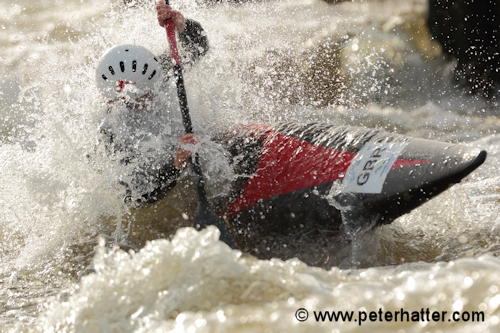 Always leave enough room in the shot to include the water. It is this that defines the sport and is a crucial element to a successful image. Frame your shot
such that the paddler is obviously negotiating a very tricky hazard. Think drama,drama,drama!
It is important to remember that whilst you are there to capture some great action, these people are competing in a live sporting event so at various places
around the course there will be organisers, judges and officials. At all times remember that the places from where you choose to take your photographs must
never interfere with the safety or running of the event.
Always leave enough room in the shot to include the water. It is this that defines the sport and is a crucial element to a successful image. Frame your shot
such that the paddler is obviously negotiating a very tricky hazard. Think drama,drama,drama!
It is important to remember that whilst you are there to capture some great action, these people are competing in a live sporting event so at various places
around the course there will be organisers, judges and officials. At all times remember that the places from where you choose to take your photographs must
never interfere with the safety or running of the event.
Remember too that these courses are on fast moving water where you don't want to fall in or drop a piece of your equipment. You will be very close to the water
and the competitors so always think safety first and photography second. At some venues you will be required to wear a boyancy aid if you are next to the water. That is if you can
get that close. Different venues will have different rules. These events take place from March to October throughout the UK and there are various sporting bodies
that can provide you with more information. A good place to start is the official organising body for canoe sports in the UK, the BCU (http://www.bcu.org.uk/)
My top 10 quick tips for capturing great white water canoe action :
1. Arrive early to check out the course and find the best spots.
2. Check your background. A clean background without any distractions will give your main subject more impact straight away.
3. Use a wide aperture. This not only narrows the depth of field to throw the background out of focus, it also means you will have access to your faster shutter speeds.
4. Use a fast shutter speed. This will capture the moment in great detail and reduce blur. The water around the canoeist will be frozen adding even more drama to the image. An ideal shutter speed is 1/500th of a second or faster.
5. Watch out for the white water under-exposing your image.
6. Pick a location to shoot from that safely gives you the most predictable action.
7. The eyes of the canoeist must be in focus.
8. Watch for arms and paddles covering faces.
9. Keep all of the little details of the canoeist, such as the ends of paddles in the frame.
10. Pick a spot that does not obstruct the officials who are running the event or scoring the canoeists. \n";
If you enjoyed this article why not take a look at our next article, Seeing a Photograph - Click Here.
Remember to always think safety first when you're out shooting sports. Never put yourself or others in danger and always observe all safety notices and instructions.
