
Sports Photography Tips - Watch The Background.
 As soon as I am commissioned to photograph a sport, my first thought is what will the background be? If I have any choice in how I compose the picture,
(sometimes as a sports photographer
you have to go where you are put by officialdom) I will look for a background that will complement the subject.
As soon as I am commissioned to photograph a sport, my first thought is what will the background be? If I have any choice in how I compose the picture,
(sometimes as a sports photographer
you have to go where you are put by officialdom) I will look for a background that will complement the subject.
Generally there are two types of background. The out-of-focus (OOF) background and the background containing a lot of detail.
My favourite is the OOF because this removes any distractions going on behind your subject and leaves your eye to view only the main activity in your sports photograph.
This technique is achieved with standard (50mm) or longer telephoto lenses, combined with a wide aperture such as f2.8.
Using a 50mm lens at f2.8 the background of for example a head and shoulders portrait will be nicely out of focus.
By using this technique you are exploiting the aperture's Depth Of Field (DOF).
DOF is the area of focus in front of the lens. It can be measured in centimetres or kilometres.
A wide aperture like f2.8 gives you a short depth of field (or area of sharp focus) in which you place your subject. Anything outside the area of depth
of field is out of focus.
(A new word for this out of focus area is bokeh and is very popular now).
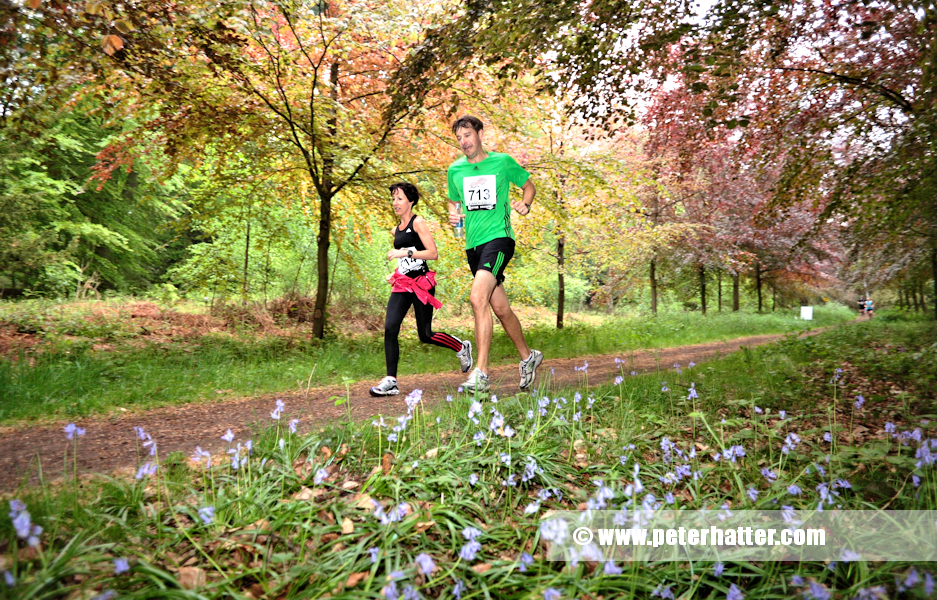 However there may be a time when the sport you a photographing takes place somewhere that adds so much to the sense of what is happening in your shot.
Time then to take that photograph using a smaller aperture like f8. As the aperture becomes smaller, the area in focus extends in front of and behind the subject
(Assuming of course the subject
is in perfect focus no matter what the aperture is set to.) A typical sport where this might apply is a fell running event where the race takes place in a landscape
that would be ripe for a photograph
even if there were no sporting action taking place. So by reducing that aperture and extending that depth of field more of the background is revealed to the viewer
of your sports picture.
However there may be a time when the sport you a photographing takes place somewhere that adds so much to the sense of what is happening in your shot.
Time then to take that photograph using a smaller aperture like f8. As the aperture becomes smaller, the area in focus extends in front of and behind the subject
(Assuming of course the subject
is in perfect focus no matter what the aperture is set to.) A typical sport where this might apply is a fell running event where the race takes place in a landscape
that would be ripe for a photograph
even if there were no sporting action taking place. So by reducing that aperture and extending that depth of field more of the background is revealed to the viewer
of your sports picture.
Remember as we said earlier that the focal length of your lens will also play a part here. Longer focal lengths have a shorter depth of field. At the same aperture
a 135mm lens will have a much
shorter DOF than a 50mm lens and a 20mm lens will have a longer DOF than the 50mm.
Many professional sport photographers exploit this technique when using a telephoto lens for their work. The background is nicely blurred at typical telephoto lengths
ensuring the viewer’s
eye is drawn immediately to the main feature of the photograph.
Quick Tip When you find an interesting subject, think about how the background will work with that subject.
If you enjoyed this article why not take a look at our next article, Take Better Canoe Slalom Images - Click Here.
Remember to always think safety first when you're out shooting sports. Never put yourself or others in danger and always observe all safety notices and instructions.
